
LETTERS FOR YOUR DOCTOR - WHICH ONE TO USE AND HOW
Updated: Nov 9
Here are letters to help you stand up for yourself when a doctor is dismissive. Each one is backed by research and sources your doctor can check, and is ready to copy and paste into an email or your patient portal, or to print and bring to your appointment.
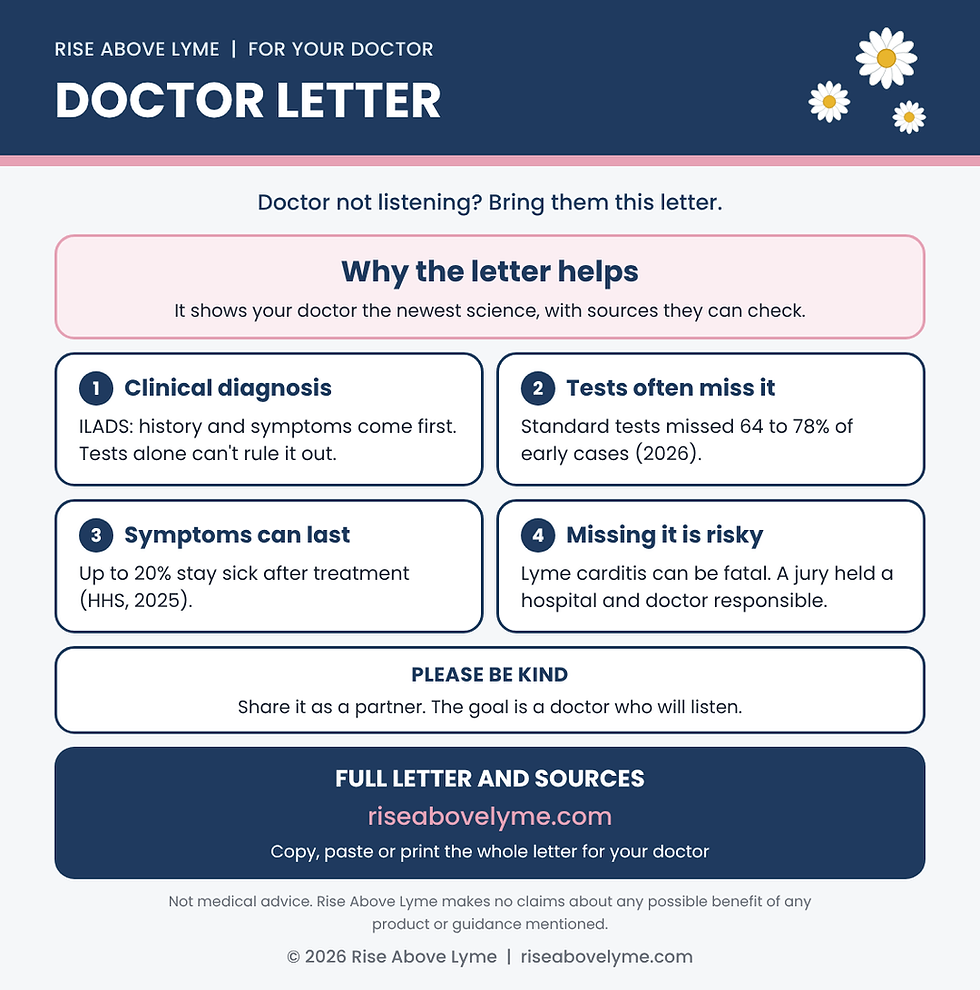
There is a quick-view graphic with the key points at the bottom of this post.
WHICH LETTER SHOULD I BRING?
- Seeing your primary care doctor, or any doctor without their own letter? Bring the Doctor Letter.
- Seeing a specialist? Bring that doctor's letter: the Neurologist, Cardiologist or Gastroenterologist Letter. Each one includes the key testing facts.
- Is testing the problem? If your doctor says a negative test rules out Lyme, brushes off a positive test, or won't consider Lyme at all, bring the Lyme Testing Letter.
- Seeing a specialist, and testing is also the problem? Bring that doctor's letter to the visit, and send the Lyme Testing Letter a few days before through your patient portal so your doctor has time to read it.
Bring just one letter to the visit. A doctor is much more likely to read one letter than a stack of pages.
HOW TO USE A LETTER
1. Open the letter you need below.
2. Copy everything from "COPY FROM HERE" down to the end of the sources.
3. Paste it into a message in your patient portal or an email, or print it.
4. Add your name at the bottom where it says (Your name).
5. If you're sending it, send it a few days before your appointment so your doctor has time to read it.
THE LETTERS
DOCTOR LETTER
For any doctor. It shares the newest Lyme science, what the government now recognizes and why dismissing Lyme can be dangerous.
LYME TESTING LETTER
For any doctor who is relying on a test result alone. It shows why a negative test doesn't rule out Lyme and why a positive IGeneX result should be taken seriously, backed by ILADS, top universities, the FDA, government reports and state laws.
NEUROLOGIST LETTER
For your neurologist. It shares the newest research on how Lyme and its co-infections can affect the brain and nerves, including neuropathy, facial palsy, dysautonomia and stroke.
CARDIOLOGIST LETTER
For your heart doctor. It explains how Lyme and its co-infections can affect the heart, and asks that your heart be checked carefully.
GASTROENTEROLOGIST LETTER
For your gut doctor. It explains how Lyme and its co-infections can affect the gut and liver.
RELATED POSTS
DISMISSIVE DOCTORS
LYME LITERATE DOCTORS

Disclaimer: Rise Above Lyme makes no claims about any possible benefit of using any product mentioned within this site. Always consult with your doctor before adding anything. The information shared is based on personal experience, years of accumulated researched resources from Lyme Literate doctors and polls conducted within Lyme groups from actual patient experience using these solution ideas.

Comments