
DOCTOR LETTER
Updated: Nov 10
This letter is for you to give to your doctor. Copy and paste it into an email or your patient portal, or print this page and bring it to your appointment. Add your name at the bottom. Every point is backed by a source listed at the end, so your doctor can check it for themselves.
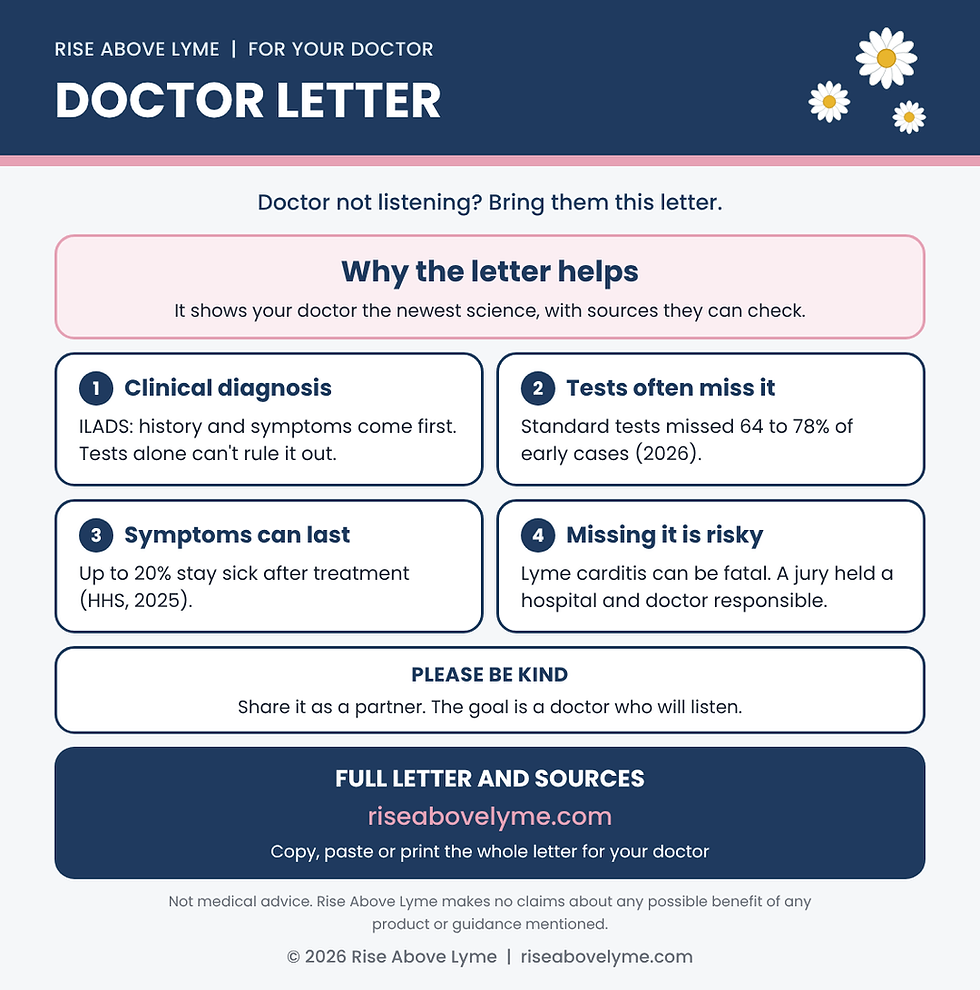
There is a quick-view graphic with the key points at the bottom of this post.
WHICH LETTER SHOULD I BRING?
- Seeing your primary care doctor, or any doctor without their own letter? Bring the Doctor Letter.
- Seeing a specialist? Bring that doctor's letter: the Neurologist, Cardiologist or Gastroenterologist Letter. Each one includes the key testing facts.
- Is testing the problem? If your doctor says a negative test rules out Lyme, brushes off a positive test, or won't consider Lyme at all, bring the Lyme Testing Letter.
- Seeing a specialist, and testing is also the problem? Bring that doctor's letter to the visit, and send the Lyme Testing Letter a few days before through your patient portal so your doctor has time to read it.
Bring just one letter to the visit. A doctor is much more likely to read one letter than a stack of pages.
COPY FROM HERE
Dear Doctor,
Thank you for taking the time to read this. I know your schedule is full, and I'm grateful you're willing to look at it with an open mind.
A lot has changed in Lyme disease research over the last few years. Major medical centers, medical journals, the National Academies and the U.S. Department of Health and Human Services now recognize that Lyme can cause long-lasting illness, that standard testing often misses it, and that patients have too often been dismissed. I'm sharing this so we can work together as partners in my care.
LYME IS A CLINICAL DIAGNOSIS
The International Lyme and Associated Diseases Society (ILADS) teaches that Lyme is a clinical diagnosis, based on a patient's history, symptoms and possible tick exposure. Lab tests can support the diagnosis, but on their own they can't make or rule out the diagnosis. ILADS also shares that:
- Fewer than 30% of people with Lyme in the U.S. remember a tick bite.
- Fewer than 20% of Lyme rashes look like the classic bull's-eye.
- Some patients have flu-like symptoms with no rash, or no memory of one, so doctors should still consider Lyme where it is common, even without that sign.
- Some patients never test positive for antibodies, even when tested again and again.
- Co-infections like Babesia, Bartonella, Anaplasma and Ehrlichia should be considered too.
- A well-done meta-analysis found that lasting Lyme symptoms form their own distinct pattern, different from fibromyalgia, depression and chronic fatigue.
- A significant number of patients don't get back to their pre-Lyme health after short courses of antibiotics, which is why ILADS recommends 4 to 6 weeks of antibiotics for patients with a Lyme rash.
WHAT TO KNOW ABOUT LYME TESTING
- A 2026 study in the Journal of Clinical Microbiology found that common FDA-cleared two-tier testing missed 64% to 78% of early Lyme cases.
- A 2025 Lyme Disease Biobank study found that standard two-tier testing was positive in only 34% of patients who had a Lyme rash larger than 5 cm (about 2 inches). About 1 in 5 patients (22%) still had symptoms at follow-up, and the authors encouraged doctors to check in with their patients and consider prompt antibiotic re-treatment when appropriate.
- In December 2025, HHS stated that today's tests often fail to catch Lyme, both early in the infection and in later stages.
- IGeneX is a CLIA-certified lab licensed by New York State, and its Lyme ImmunoBlots are the foundation of two FDA-cleared test kits (IgG 2024, IgM 2025). A positive result from IGeneX deserves to be evaluated, not dismissed.
- Many states have Lyme laws. Maryland and Rhode Island laws require that patients be told a negative Lyme test does not necessarily mean they don't have Lyme.
LONG-TERM SYMPTOMS ARE REAL AND COMMON
- The National Academies of Sciences, Engineering, and Medicine (2025) noted that the commonly cited estimate is 10% to 20% of people treated for Lyme having prolonged symptoms, lasting for months, years or even decades. The report states that its name for these illnesses "affirms the authenticity and impacts of the symptoms," and that the lack of tests has often led to "stigmatization and dismissal."
- HHS (December 2025): "For up to 20 percent of patients, symptoms persist and progress into Lyme infection-associated chronic conditions and illnesses."
- The National Institutes of Health (2023) states that 10% to 20% of people with Lyme develop post-treatment Lyme disease syndrome, with symptoms like pain, fatigue and trouble thinking.
- Johns Hopkins (2022): in a study of patients who were diagnosed early and treated correctly, 13.7% met the criteria for post-treatment Lyme disease, compared with 4.1% of a comparison group who never had Lyme.
THE SCIENCE IS CATCHING UP
- Northwestern University (2025): researchers reported that pieces of the Lyme bacterium's cell wall stay in patients' joint fluid weeks to months after treatment, and their new study (Science Translational Medicine) showed how these pieces can linger in the body, which may help explain ongoing symptoms.
- Johns Hopkins and Stanford (Frontiers in Immunology, 2025): patients with post-treatment Lyme had measurable differences in their immune cells compared with healthy people.
- Tulane University: Dr. Monica Embers, who studies Lyme in non-human primates, has said their work shows that doxycycline, the most common Lyme antibiotic, "is unable to cure the infection, especially when the subjects are treated later in the infection." In her monkey study, intact Lyme bacteria were found in the brains of two monkeys that had been treated with a 28-day course of doxycycline. This was an animal study.
- Tulane University (Frontiers in Microbiology, 2023): in mice, no single antibiotic fully cleared a persistent Lyme infection after a 28-day course, while some combinations of antibiotics did. This was a lab study in mice.
- Columbia and Johns Hopkins researchers (2025) proposed research criteria for Lyme-related chronic illness, so more patients can be included in studies.
- The National Institutes of Health is funding a $20.7 million study at Tufts (2024), its largest prospective Lyme study to date, to find the causes of persistent symptoms.
THE U.S. GOVERNMENT NOW RECOGNIZES THE PROBLEM
- There are two different medical guidelines for Lyme, one from ILADS and one from the IDSA. Congress created the HHS Tick-Borne Disease Working Group in 2016. In its final report (2022), it asked that federal websites, beginning with the CDC and NIH, be updated to show that the science on persistent and chronic Lyme is "limited, emerging, and unsettled" and that there are "divergent views on diagnosis and treatment." The same report noted that no tests exist to prove the infection has been cleared.
- The Kay Hagan Tick Act became law in 2019. It is named after U.S. Senator Kay Hagan, who died from complications of Powassan virus, a tick-borne virus. Congress renewed it, and the renewal was signed into law on September 30, 2026.
- The Department of Defense funds a Tick-Borne Disease Research Program, and says more must be learned about the cause of lasting Lyme symptoms.
- In December 2025, HHS renewed its LymeX program as a $10 million effort to improve Lyme diagnostics. The HHS Secretary said, "For decades, Americans suffering from Lyme disease have been denied the accurate diagnostics and meaningful care they deserve." HHS also estimated that 5 to 7 million Americans have been infected with Lyme over the past decade.
- In May 2026, HHS announced a partnership with ILADS. Patients can now find ILADS's clinician locator through hhs.gov/lyme. HHS also estimates that over 476,000 people in the U.S. are diagnosed with Lyme every year.
- The Bay Area Lyme Foundation (2026) estimates the real number is even higher, about 627,927 cases in 2024. This is based on the 476,000 yearly estimate from insurance-claims data, plus about 5% growth each year. Lyme has been reported in all 50 states.
MISSING LYME CAN BE DANGEROUS
- Peter Smith was 25 when he died of Lyme carditis in 2017. At a hospital in Portland, Maine, he was seen for a rash, fever, chills, dizziness and headache. His doctor noted a target-shaped spot but recorded no sign of Lyme and diagnosed a skin infection. In 2023, a jury ordered the hospital and doctor to pay $6.5 million to his family. In 2025, Maine's highest court threw out the $2 million awarded for lost future earnings, but the finding that the doctor was responsible for his death still stands.
- Joseph Elone was 17 when he died of Lyme carditis in 2013. His family lived in Poughkeepsie, New York. As LymeDisease.org reported, a standard Lyme test was used to wrongly rule out his Lyme. His parents sued four doctors, a pediatric practice and a hospital for failing to properly treat him, and the case settled in 2023, just days before trial.
- In a case reported in 2023, a Baltimore jury awarded $792,000 to Daniel Riddic. His Lyme was first diagnosed as cellulitis and then as an allergic reaction, and he was later diagnosed with Lyme meningitis.
- Dr. Neil Spector, a top cancer researcher at Duke Cancer Institute, had Lyme disease that was misdiagnosed at first. By the time he was treated, Lyme carditis had permanently damaged his heart, and in 2009, after near-fatal heart failure, he needed a heart transplant.
- Mass General researchers (PLOS ONE, 2021) studied more than 96,000 Lyme hospitalizations in the U.S. About 11% had Lyme carditis, and patients with Lyme carditis died in the hospital three times as often (1.5% compared with 0.5%).
WHAT I'M ASKING
- Please listen to my history and symptoms, even if my tests are negative.
- Please don't rule out Lyme because I don't remember a tick bite or never saw a rash.
- Please consider Lyme and its co-infections as a clinical diagnosis.
- If this isn't an area you treat, please help me find a doctor who does. ILADS's clinician locator is available through hhs.gov/lyme.
- Being believed matters to me. In a Johns Hopkins study, post-treatment Lyme patients who felt dismissed by providers had worse symptoms and quality of life (Rebman et al., 2024). Dr. Robert Bransfield (Rutgers, 2017) found that Lyme and associated diseases contributed to suicidal thoughts in some people who were not suicidal before, and that negative attitudes toward Lyme from family, friends and doctors may add to that risk.
- Please work with me as a partner. I want to get better, and I believe we can do that together.
WHERE THIS RESEARCH COMES FROM
The studies in this letter include research from Johns Hopkins, Stanford, Columbia, Northwestern, Tulane, Tufts, Rutgers and Mass General, and from the Bay Area Lyme Foundation's Lyme Disease Biobank. It also draws on FDA reviews and state Lyme laws.
Thank you for your time, your care and your willingness to learn more about this illness with me.
Sincerely,
(Your name)
SOURCES
IGeneX - Licenses and Certifications
IGeneX - FDA Clearance
FDA 510(k) Decision Summary - iDart Lyme IgG ImmunoBlot Kit, K233367 (August 2024)
FDA 510(k) Decision Summary - iDart Lyme IgM ImmunoBlot Kit, K242872 (June 2025)
Maryland Health-General Section 20-1701
https://mgaleg.maryland.gov/mgawebsite/Laws/StatuteText?article=ghg§ion=20-1701&enactments=false
Rhode Island General Laws Section 5-37.5-6, Lyme disease testing information disclosure
ILADS - Lyme Disease Basics for Providers (updated 2026)
Bay Area Lyme Foundation - Study shows common FDA-cleared Lyme tests miss 64-78% of early cases (Journal of Clinical Microbiology, April 2026)
Frontiers in Medicine - Lyme Disease Biobank: 10 years of 3 month follow-up visits (July 2025)
HHS - Secretary Kennedy Convenes Lyme Disease Patients and Providers to Announce New Diagnostic Efforts (December 2025)
National Academies - Charting a Path Toward New Treatments for Lyme Infection-Associated Chronic Illnesses (May 2025)
National Institutes of Health - NIH Awards Will Fund Post-Treatment Lyme Disease Syndrome Research (July 2023)
Johns Hopkins - Risk of post-treatment Lyme disease in patients with ideally-treated early Lyme disease (International Journal of Infectious Diseases, 2022)
Northwestern University - Post-Treatment Lyme Disease Syndrome May Be Driven by Remnants of Infection (May 2025)
Johns Hopkins and Stanford - Immune cell differences in post-treatment Lyme disease (Frontiers in Immunology, July 2025)
Tulane University - Lyme researcher seeks answers to evasive disease (November 2022)
Tulane University - Crossland, Alvarez and Embers, monkey study of Lyme after doxycycline (American Journal of Pathology, 2018) (older source, still worth reading)
Tulane University - Combined antibiotics more effective against Lyme disease (December 2023)
Frontiers in Medicine - Proposed research classification criteria for Lyme disease in infection associated chronic illness studies (February 2025)
Tufts University School of Medicine - Large-scale study will seek to unearth causes of persistent symptoms of Lyme disease (September 2024)
HHS Tick-Borne Disease Working Group - 2022 Report to Congress
Kay Hagan Tick Act - health.gov
Global Lyme Alliance - The Kay Hagan Tick Reauthorization Act is signed into law (October 2026)
Kay Hagan Tick Reauthorization Act, Public Law 119-118 (September 2026)
Department of Defense - Tick-Borne Disease Research Program
HHS - HHS Unveils Sweeping Plan to Combat Lyme Disease and Advance Treatment (May 2026)
HHS - Lyme Disease (Clinician Locator)
Bay Area Lyme Foundation - Lyme Disease Facts and Statistics (updated 2026)
Maine Public - Mercy Hospital, physician ordered to pay $6.5 million in wrongful death suit (February 2023)
Maine Supreme Judicial Court - Smith v. Henson, 2025 ME 55 (June 2025)
LymeDisease.org - Mary Beth Pfeiffer on the Joseph Elone lawsuit settlement (May 2023)
The Daily Record - Baltimore jury awards nearly $800K to man whose severe Lyme disease was misdiagnosed (February 2023)
Duke Health - Bay Area Lyme Foundation grant honors Spector (September 2023)
Mass General - Lyme carditis in U.S. hospitalizations (PLOS ONE, 2021)
Rebman AW, Yang T, Aucott JN - Invalidation by medical professionals in post-treatment Lyme disease (Scientific Reports, 2024)
Bransfield RC - Suicide and Lyme and associated diseases (Neuropsychiatric Disease and Treatment, 2017, older source, still worth reading)

Comments