
CARDIOLOGIST LETTER
Updated: 20 hours ago
This letter is for you to give to your cardiologist, so they understand how Lyme disease and its co-infections can affect the heart, take you seriously and screen you properly. Copy and paste it into an email or your patient portal, or print this page and bring it to your appointment. Add your name at the bottom. Every point is backed by a source listed at the end, so your doctor can check it for themselves.
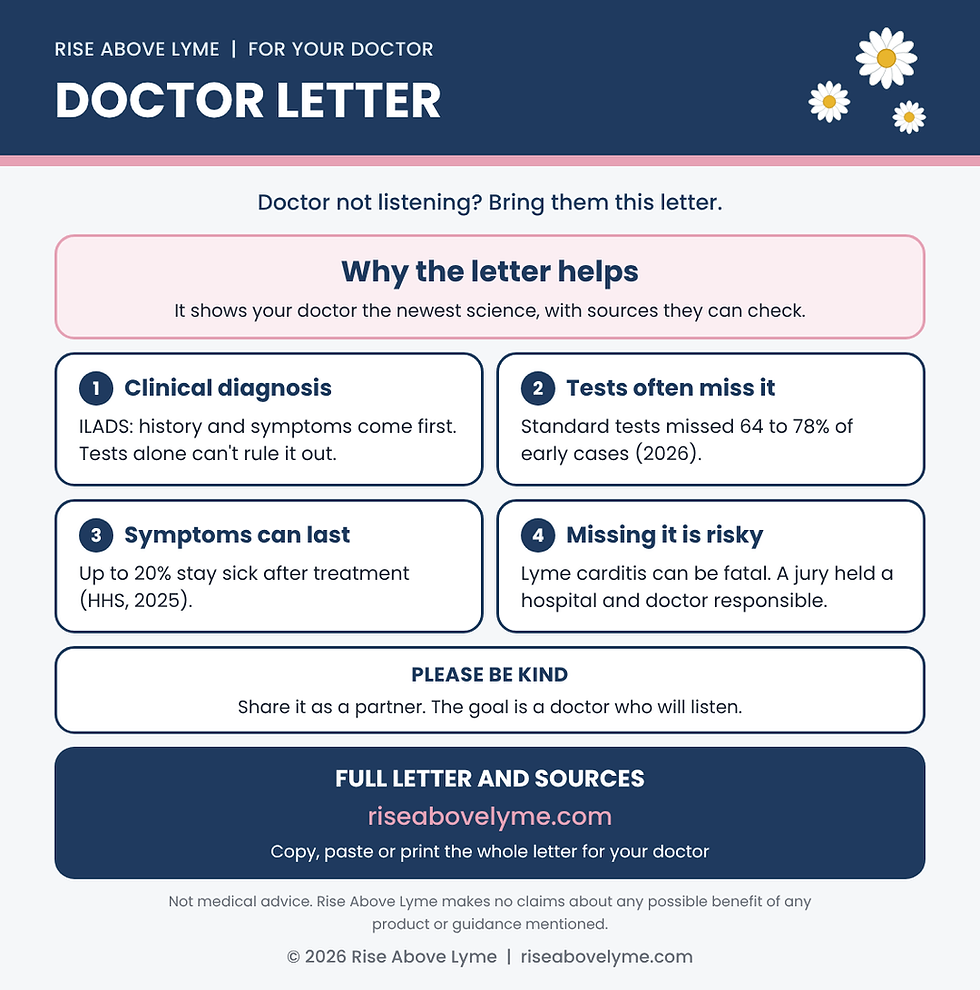
There is a quick-view graphic with the key points at the bottom of this post.
COPY FROM HERE
Dear Doctor,
Thank you for taking the time to read this. Because of my Lyme disease (and/or tick-borne co-infections), I'm asking that my heart be carefully screened and monitored. I'm not asking you to have all the answers. I'm asking you to keep an open mind, because a lot of new information about Lyme and the heart has come out in the last few years.
WHAT ILADS TEACHES
- The International Lyme and Associated Diseases Society (ILADS) teaches that Lyme is a clinical diagnosis, and that lab results can't make or rule out the diagnosis on their own. A negative test does not rule out Lyme.
- Fewer than 30% of people with Lyme in the U.S. remember a tick bite, and fewer than 20% of Lyme rashes look like the classic bull's-eye. ILADS also notes that some patients have flu-like symptoms with no rash, or no memory of one, and that doctors should still consider Lyme where it is common, even without that sign.
- ILADS lists palpitations, chest pain, shortness of breath, lightheadedness and fainting among the symptoms of Lyme.
- ILADS notes that Bartonella is associated with myocarditis and endocarditis.
- In May 2026, the U.S. Department of Health and Human Services (HHS) announced a partnership with ILADS. Patients can now find ILADS's clinician locator through hhs.gov/lyme.
- Please know there are two different medical guidelines for Lyme, one from ILADS and one from the IDSA. In its final report to Congress (2022), the federal Tick-Borne Disease Working Group asked that federal websites acknowledge there are divergent views on diagnosing and treating persistent and chronic Lyme.
WHAT TO KNOW ABOUT LYME TESTING
- Standard tests miss many infections. A 2026 study in the Journal of Clinical Microbiology found the FDA-cleared two-tier testing methods it compared across all early Lyme cases missed 64% to 78% of those cases at the first blood draw.
- IGeneX is a CLIA-certified lab licensed by New York State, and its Lyme ImmunoBlots are the foundation of two FDA-cleared test kits (IgG 2024, IgM 2025). A positive result from IGeneX deserves to be evaluated, not dismissed.
- Many states have Lyme laws. Maryland and Rhode Island laws require that patients be told a negative Lyme test does not necessarily mean they don't have Lyme.
LYME CAN AFFECT THE HEART
- Mass General cardiologists (PLOS ONE, 2021) note that Lyme carditis affects up to 10% of patients with Lyme disease. In their study of more than 96,000 U.S. Lyme hospitalizations, about 11% of patients had Lyme carditis.
- Dr. Adrian Baranchuk, a cardiologist and Lyme carditis expert, has estimated that about 3% to 5% of people with Lyme may have heart involvement (Bay Area Lyme Foundation, 2023).
- When heart block has no other clear cause, Dr. Baranchuk advises considering Lyme carditis, and when it looks likely, ordering Lyme blood tests right away and starting antibiotics (Bay Area Lyme Foundation, 2023).
PLEASE CONSIDER LYME BEFORE A PERMANENT PACEMAKER
- Dr. Baranchuk's advice to fellow doctors: before implanting a pacemaker, consider Lyme carditis (Bay Area Lyme Foundation, 2023).
- Mass General researchers (PLOS ONE, 2021) found that 11% of patients with heart-rhythm problems from Lyme carditis received a permanent pacemaker. They note that heart-rhythm guidelines advise against a permanent pacemaker during acute Lyme carditis, because the heart block is expected to resolve with treatment.
- Even the IDSA guideline (2020), which many doctors follow, strongly recommends temporary pacing, rather than a permanent pacemaker, when a patient with Lyme carditis needs pacing for a slow heart rate.
MISSING IT CAN BE DANGEROUS
- Mass General researchers (PLOS ONE, 2021) also found that patients with Lyme carditis died in the hospital three times as often as other hospitalized Lyme patients (1.5% compared with 0.5%).
- Peter Smith was 25 when he died of Lyme carditis in 2017. At a hospital in Portland, Maine, his doctor noted a target-shaped spot but recorded no sign of Lyme and diagnosed a skin infection. In 2023, a jury ordered the hospital and doctor to pay $6.5 million to his family. In 2025, Maine's highest court threw out the $2 million awarded for lost future earnings, but the finding that the doctor was responsible for his death still stands.
- Joseph Elone was 17 when he died of Lyme carditis in 2013. His family lived in Poughkeepsie, New York. As LymeDisease.org reported, a standard Lyme test was used to wrongly rule out his Lyme. His parents sued four doctors, a pediatric practice and a hospital, and the case settled in 2023, just days before trial.
- Dr. Neil Spector, a top cancer researcher at Duke Cancer Institute, had Lyme disease that was misdiagnosed at first. By the time he was treated, Lyme carditis had permanently damaged his heart, and in 2009, after near-fatal heart failure, he needed a heart transplant.
CO-INFECTIONS CAN AFFECT THE HEART TOO
- Babesia: in a Yale study of 163 patients hospitalized with babesiosis (Clinical Infectious Diseases, 2022), about 1 in 5 had at least one heart complication, including atrial fibrillation, heart failure, QT prolongation and cardiac ischemia. Patients with heart complications died more often (9.4% compared with 0.8%).
- Bartonella: the American Heart Association (2025) lists Bartonella among the hard-to-culture germs that can cause blood culture-negative endocarditis, so it may not show up on standard blood cultures.
POTS AND DYSAUTONOMIA
- Johns Hopkins (2026) lists Lyme disease among the conditions known to potentially cause autonomic neuropathy, which can lead to POTS.
- Johns Hopkins researchers (Frontiers in Neurology, 2024) reviewed the evidence linking the Lyme bacterium to dysautonomia, noted that it is recognized in the care of patients with post-treatment Lyme disease, and asked whether it may be a key part of the illness.
- A 2025 study from Serbia (Biomedicines) found orthostatic hypotension in 53.4% of patients with late-stage Lyme.
WHAT I'M ASKING
- Please ask me about heart symptoms, like palpitations, chest pain, lightheadedness, fainting or shortness of breath.
- Please don't rule out Lyme because I don't remember a tick bite or never saw a rash.
- If I have heart block, please consider Lyme carditis before a permanent pacemaker.
- Please consider co-infections like Babesia and Bartonella, and use your judgment on which tests fit my symptoms.
- If I feel worse when I stand up, please consider POTS or dysautonomia.
- Being believed matters to me. In a Johns Hopkins study, post-treatment Lyme patients who felt dismissed by providers had worse symptoms and quality of life (Rebman et al., 2024). Dr. Robert Bransfield (Rutgers, 2017) found that Lyme and associated diseases contributed to suicidal thoughts in some people who were not suicidal before, and that negative attitudes toward Lyme from family, friends and doctors may add to that risk.
- Please work with me as a partner. I want to get better, and I believe we can do that together.
WHERE THIS RESEARCH COMES FROM
The studies in this letter include research from Mass General, Yale, Johns Hopkins and Rutgers, and from a research center in Serbia. The 2026 testing study comes from the Bay Area Lyme Foundation's Lyme Disease Biobank, and the letter also draws on FDA reviews and state Lyme laws.
Thank you for your time, your care and your willingness to learn more about this illness with me.
Sincerely,
(Your name)
SOURCES
Horn et al. - Evaluation of Standard and Modified Two-Tiered Testing Algorithms Using Well-Characterized Early Lyme Disease Samples (Journal of Clinical Microbiology, 2026)
IGeneX - Licenses and Certifications
IGeneX - FDA Clearance
FDA 510(k) Decision Summary - iDart Lyme IgG ImmunoBlot Kit, K233367 (August 2024)
FDA 510(k) Decision Summary - iDart Lyme IgM ImmunoBlot Kit, K242872 (June 2025)
Maryland Health-General Section 20-1701
https://mgaleg.maryland.gov/mgawebsite/Laws/StatuteText?article=ghg§ion=20-1701&enactments=false
Rhode Island General Laws Section 5-37.5-6, Lyme disease testing information disclosure
ILADS - Lyme Disease Basics for Providers (updated 2026)
HHS - HHS Unveils Sweeping Plan to Combat Lyme Disease and Advance Treatment (May 2026)
HHS - Lyme Disease (Clinician Locator)
HHS Tick-Borne Disease Working Group - 2022 Report to Congress
PLOS ONE - Mass General study of Lyme carditis hospitalizations in the U.S. (November 2021)
Bay Area Lyme Foundation - How to Diagnose if Lyme Disease is Affecting the Heart (Dr. Adrian Baranchuk interview, 2023, updated 2024)
Clinical Infectious Diseases - IDSA, AAN and ACR 2020 Guidelines for the Prevention, Diagnosis and Treatment of Lyme Disease
Maine Public - Mercy Hospital, physician ordered to pay $6.5 million in wrongful death suit (February 2023)
Maine Supreme Judicial Court - Smith v. Henson, 2025 ME 55 (June 2025)
LymeDisease.org - Mary Beth Pfeiffer on the Joseph Elone lawsuit settlement (May 2023)
Duke Health - Bay Area Lyme Foundation grant honors Spector (September 2023)
Clinical Infectious Diseases - Cardiac Complications of Human Babesiosis (Yale, 2022)
American Heart Association - Blood Culture-Negative Endocarditis scientific statement (Journal of the American Heart Association, 2025)
Johns Hopkins Medicine - Postural Orthostatic Tachycardia Syndrome (POTS) (2026)
Frontiers in Neurology - Dysautonomia following Lyme disease: a key component of post-treatment Lyme disease syndrome? (Johns Hopkins, February 2024)
Milovanovic et al. - Cross-Sectional Study Evaluating the Role of Autonomic Nervous System Functional Diagnostics in Differentiating Post-Infectious Syndromes: Post-COVID Syndrome, Chronic Fatigue Syndrome, and Lyme Disease (Biomedicines, 2025)
Scientific Reports - Invalidation by medical professionals in post-treatment Lyme disease (Johns Hopkins, August 2024)
Neuropsychiatric Disease and Treatment - Suicide and Lyme and associated diseases (Dr. Robert Bransfield, Rutgers, June 2017)



Comments