
INTERNAL VIBRATIONS, TREMORS, BRAIN ZAPS, ELECTRIC SHOCK SENSATIONS AND CRANIAL NEUROPATHY
Updated: 4 days ago
For those of us who have brain zaps, electric shock feelings in the brain, buzzing or internal vibrations, I gathered information to help us all understand what is happening and why.
The difference in a nutshell: a tremor is shaking you can see from the outside. Internal vibrations, which doctors also call internal tremor, are felt on the inside as buzzing or trembling, and usually nobody else can see them. A 2024 paper by Dr. Svetlana Blitshteyn and others explains this, and a 2023 Parkinson's study notes that internal tremor affects more than 30% of people with Parkinson's, so it isn't only a Lyme or long COVID symptom.
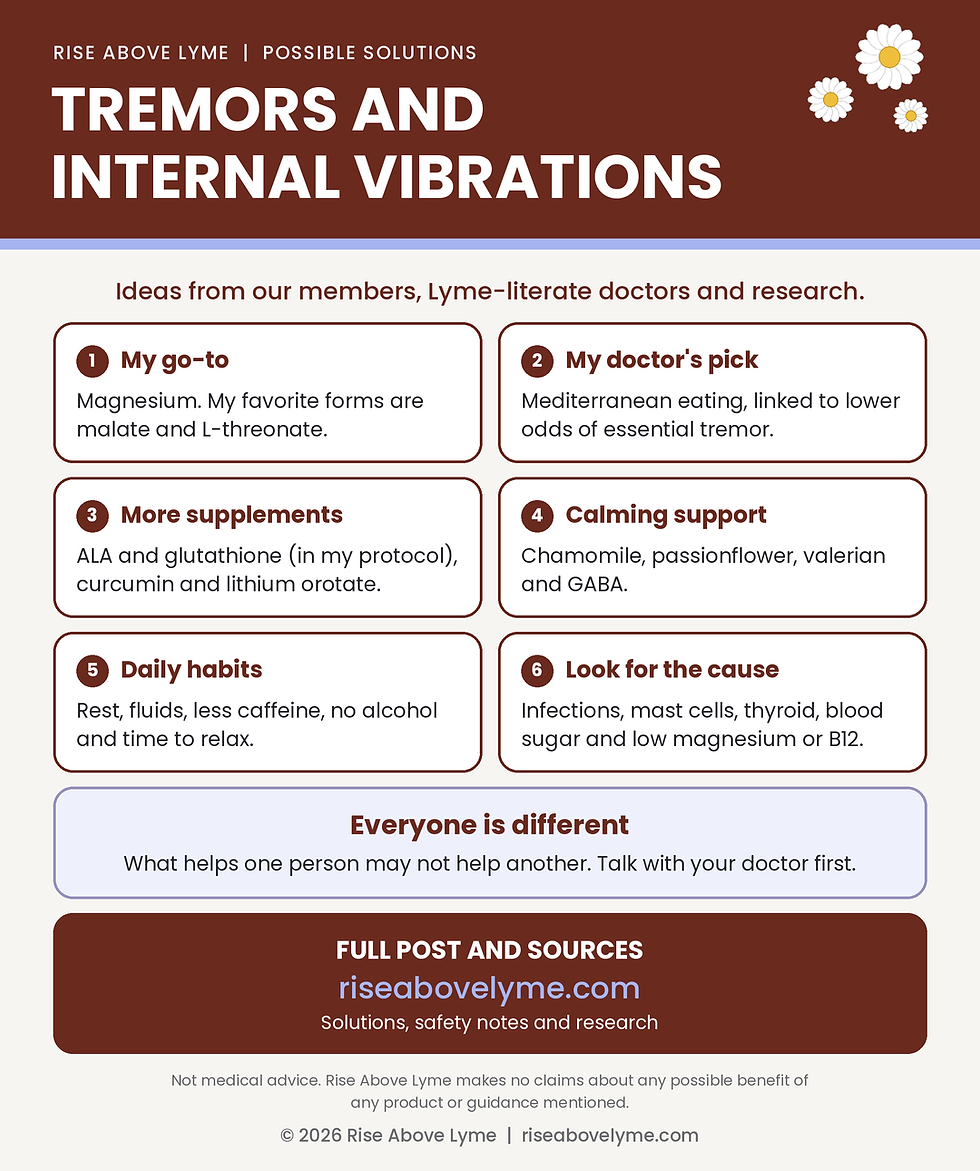
Short on time or energy? A quick-view graphic with the key points is at the bottom of this post.
Looking for things that may help? Read the solutions post:
TREMORS AND INTERNAL VIBRATIONS - POSSIBLE SOLUTIONS
WHAT THESE FEEL LIKE
TREMORS
- A tremor is a shaking movement you can't control, most often in the hands and arms. It can also affect the head, tongue or voice.
- Everyone's hands shake a little when they move. Caffeine, smoking, stress, tiredness, anger and fear can make that shaking stronger.
INTERNAL VIBRATIONS
- A feeling of buzzing, trembling or vibrating inside the body that others usually can't see.
- In their 2024 paper, Dr. Blitshteyn and her co-authors say they believe it may be part of POTS and small fiber neuropathy.
- In a 2023 Yale study of people with long COVID, many described feelings that showed up in different places and at different times, had different triggers, and were very hard to live with. Many also had frustrating experiences getting help. That study was in long COVID, not Lyme, but many of us know this feeling well.
BRAIN ZAPS
- Quick jolts that feel like a small electric shock in the head.
- They are best studied in people stopping or lowering antidepressants. In UC San Diego studies (2018 and 2022), zaps were often set off by moving the eyes side to side, and they were tied to stopping the medicine, especially suddenly. Tapering only partly helped.
- If you get brain zaps after changing a medicine, tell your doctor. Never stop a medicine on your own.
- Some of us feel sudden, sharp, stabbing pain in the head instead, often called ice pick pain. Dr. Wayne Anderson notes that Bartonella can cause ice pick-like pain, and that Babesia tends to bring odd sensations and pressure in the head (2020).
ELECTRIC SHOCK SENSATIONS
- Shock-like pain is a typical symptom of small fiber neuropathy, damage to the tiny nerves in the skin.
- A small Harvard study (2019) used skin biopsies and found small fiber neuropathy in all 10 people it tested who were still sick after Lyme treatment. Their large nerves worked normally, so standard nerve tests would likely miss it.
CRANIAL NEUROPATHY
- Cranial nerves run from the brain to the face, eyes, ears and throat. When Lyme affects them, it is called cranial neuropathy.
- The facial nerve is the one most often affected. Global Lyme Alliance says Bell's palsy, a drooping or paralysis on one or both sides of the face, is the most common sign of neurological Lyme in the U.S.
WHY THEY CAN HAPPEN WITH LYME AND CO-INFECTIONS
LYME
- Dr. Richard Horowitz lists tremors and twitching of the face or other muscles on his Lyme-MSIDS Questionnaire, and LymeDisease.org lists twitching on its symptom checklist.
- In a 2026 case report from King's College Hospital in London, a woman had a worsening tremor and trouble walking for over three years before late neurological Lyme was found. She improved with treatment.
- A small 2025 German study of 7 people with neurological Lyme in the brain found symptoms that looked like other conditions, including tremor, Parkinson's-like movement problems and seizures.
BARTONELLA
- ILADEF says Bartonella symptoms are often neurological, including numbness, tingling and muscle twitching.
- LymeDisease.org lists tremors, balance problems and numbness among common Bartonella symptoms.
- A 2024 review by NC State researchers, including Dr. Ed Breitschwerdt, linked Bartonella to cranial nerve paralysis, nerve pain and other nerve conditions.
MAST CELLS (MCAS)
- In a 2025 study by Dr. Leonard Weinstock, Dr. Lawrence Afrin, Dr. Tania Dempsey and others, tremors at rest were reported by 19% of women with MCAS, compared with 2% of women without it. In men, it was 16% compared with 3%.
POTS
- Dysautonomia International says many people with POTS also have shaking.
OTHER CAUSES TO RULE OUT
- Low magnesium (a 2023 review linked it to tremors)
- Low B12, which over time can damage nerves
- An overactive thyroid
- Low blood sugar
- Mercury and other heavy metals
- Some medicines, alcohol use or withdrawal, and too much caffeine
- Stress, anxiety and tiredness
WHEN TO CALL YOUR DOCTOR
See your doctor if a tremor:
- is worse at rest and better when you move
- lasts a long time, is severe, or gets in the way of your life
- shows up along with a headache, weakness, odd movements of the tongue, tight muscles, or any other movement you can't stop
MY EXPERIENCE
I had tremors from the very beginning of my journey with Lyme. At first they were in my hands, one hand in particular. At times they spread to my entire body. As I treated, they went away.
RELATED POSTS
MOST COMMON SYMPTOMS OF LYME, BABESIA AND BARTONELLA
BARTONELLA MOST COMMON SYMPTOMS
BRAIN AND NEUROLOGICAL EFFECTS

SOURCES
Blitshteyn and others, internal tremor (2024)
Chahine and others, internal tremor in Parkinson's (2023)
ILADEF, Tick-Borne Diseases Other Than Lyme (2024)
LymeDisease.org, Bartonella (2022)
LymeDisease.org, Lyme Disease Symptom Checklist (no date shown)
LymeDisease.org, Small fiber neuropathy and Lyme (2019, older source, still worth reading)
Global Lyme Alliance, Symptoms of Lyme Disease (no date shown)
Dr. Richard Horowitz, Lyme-MSIDS Questionnaire (no date shown)
Delaney and others, King's College Hospital, late Lyme with tremor (2026)
Hudasch and others, Hannover, neurological Lyme in the brain (2025)
Bush, Robveille, Maggi and Breitschwerdt, NC State, Bartonella and the nervous system (2024)
Weinstock, Afrin, Dempsey and others, MCAS and nerve symptoms (2025)
Massey and others, Yale, internal tremors and vibrations (2023)
Papp and Onton, UC San Diego, brain zaps (2018, older source, still worth reading)
Papp and Onton, UC San Diego, brain zap triggers (2022)
LymeDisease.org, Dr. Wayne Anderson on Lyme-related infections (2020, older source, still worth reading)
Ray and Park, low magnesium and movement disorders review (2023)
Dysautonomia International, POTS (no date shown)
MedlinePlus, Tremor (2026)
MedlinePlus, Vitamin B12 deficiency anemia (2026)
Disclaimer: Rise Above Lyme makes no claims about any possible benefit of using any product mentioned within this site. Always consult with your doctor before adding anything. The information shared is based on personal experience, years of accumulated researched resources from Lyme Literate doctors and polls conducted within Lyme groups from actual patient experience using these solution ideas.


Comments