
METHYLENE BLUE
Updated: Oct 24
Methylene blue is a prescription medicine that some Lyme literate doctors use, mostly for Bartonella and for hard-to-reach "persister" Lyme bacteria. Here's what it is, what ILADS and the research share, how Lyme literate doctors use it, and what to know before you start.
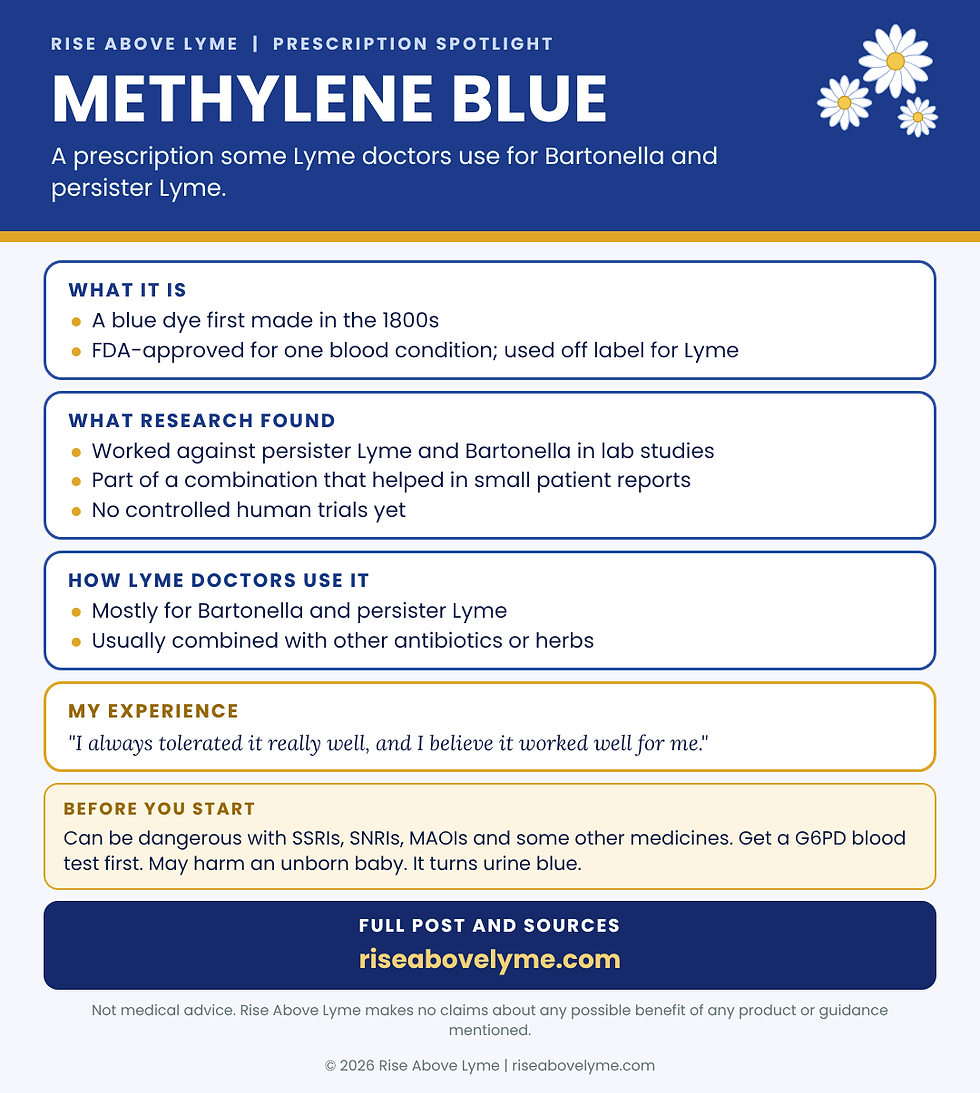
Short on time or energy? A quick-view graphic with the key points is at the bottom of this post.
MY EXPERIENCE
-I've used methylene blue a few times. I always tolerated it really well, and I believe it worked well for me. One tip: clean your toilets regularly, because it turns your urine blue!
WHAT IT IS
-Methylene blue is a blue dye first made in the late 1800s, and by 1891 it was shown to treat malaria.
-Today the FDA has approved it for only one use: treating methemoglobinemia, a blood condition. Lyme literate doctors prescribe it "off label," usually as a capsule made by a compounding pharmacy.
WHAT ILADS SHARES
-ILADS has offered education to doctors on methylene blue, including a 2023 webinar and a 2023 conference lecture on using it for chronic infections.
-In a 2024 article for ILADEF (the International Lyme and Associated Diseases Educational Foundation, a sister organization of ILADS), Dr. Richard Horowitz explains that he uses methylene blue as part of a persister combination for patients with Lyme and Bartonella. He shares that higher doses helped him treat Bartonella more effectively.
LYME AND BARTONELLA RESEARCH
-2023 and 2024 reports by Dr. Horowitz: Patients with Lyme and co-infections like Bartonella and Babesia who hadn't improved enough after long treatment got better on a persister combination that included methylene blue. One report reviewed 25 patients' charts, and the other described 3 patients. Methylene blue was one of several medicines, so the results can't be credited to it alone.
-Global Lyme Alliance (2025) notes that methylene blue's benefits for Lyme and Bartonella so far come from lab studies, and more research is needed. As of 2026, I couldn't find any controlled human trial for Lyme or its co-infections.
-2020 Johns Hopkins lab study (Bartonella): Methylene blue was one of the two most active single drugs against biofilm Bartonella, and also showed activity against dormant Bartonella. Paired with rifampin or azithromycin, it cleared dormant Bartonella in the lab within a day and biofilm Bartonella within 6 days. The researchers say animal and human studies are still needed.
-2019 Johns Hopkins lab study (Bartonella): In a screen of FDA-approved drugs, methylene blue was one of six that completely cleared dormant Bartonella in the lab after 3 days.
-2015 Johns Hopkins lab study (Lyme): Methylene blue worked better than the standard Lyme antibiotics against persister Lyme bacteria in the lab.
-Babesia: A 2020 lab study found methylene blue was active against Babesia bovis, a type of Babesia found in cattle. The researchers note that earlier animal studies of methylene blue for Babesia were disappointing. I couldn't find any studies in people with Babesia.
BRAIN AND ENERGY RESEARCH
-Methylene blue is also being studied for the brain and the cell's energy factories (mitochondria). A 2017 research review explained it this way: "In addition to its beneficial effect on mitochondrial protection, MB is also known to have robust effects in mitigating neuroinflammation. Mitochondrial dysfunction has been identified as a seemingly unifying pathological phenomenon across a wide range of neurodegenerative disorders, which thus positions methylene blue as a promising therapeutic."
-Most of that research is in labs and animals. A 2025 University of South Carolina pharmacologist says the human studies so far have mostly been small, Alzheimer's trial results have been mixed, and much larger, longer trials are needed before we know if it truly helps the brain.
HOW LYME LITERATE DOCTORS USE IT
-Dr. Marty Ross uses it for Bartonella and persister Lyme, usually 50 mg twice a day as a compounded capsule. For Bartonella, he advises taking treatment every day rather than pulsing it. He pairs it with other antibiotics or herbs, and says methylene blue with fluconazole (or a similar antifungal) seems best for clearing Bartonella brain fog.
-Dr. Horowitz uses it in a pulsed persister combination and shares that he raises the dose slowly, week by week, to make sure it's tolerated.
-Dr. Bill Rawls says it has potential for Lyme and co-infections, especially Bartonella. He notes 50 mg twice a day is a typical dose, and that herx reactions are not unusual.
-Dr. Todd Maderis points to the Johns Hopkins lab studies and says that, because ciprofloxacin can be toxic, the methylene blue combinations are a better option for persistent Bartonella.
-Dr. Susan Marra's office shares that research on persistent Bartonella looks promising, and recommends a G6PD blood test first.
-Dr. Daniel Jaller suggests starting low, at 50 mg twice a day, and slowly increasing as tolerated. He notes that its use for Lyme is based on lab (test tube) studies, so long-term use is still experimental.
-Dr. Erica Lehman, a LymeDisease.org board member, shares that her patients have seen improvement in symptoms like fatigue, depression and brain fog, and that it has helped her lower antibiotic use.
-Dr. Jill Carnahan shares that a lot of doctors who treat chronic Lyme have used it, and that it's especially good for Bartonella, which is hard to treat.
-Every Lyme doctor has their own approach. Talk with your doctor before starting.
BEFORE YOU START
-Antidepressants and other medicines: The FDA label warns that methylene blue can cause serotonin syndrome, which can be serious or even fatal, when combined with SSRIs, SNRIs, MAOIs, opioids and some other medicines. Never stop or change a medicine on your own. Your prescriber can guide any changes.
-G6PD deficiency: People with G6PD deficiency should not take it, because it can break down red blood cells. Many Lyme doctors check G6PD with a blood test first.
-Pregnancy and breastfeeding: It may harm an unborn baby. The FDA label says not to breastfeed during treatment and for up to 8 days after.
-Foods: Some sources advise avoiding high-tyramine foods like aged cheeses and cured meats, and alcohol, while taking it.
-Blue color: Urine and stool turn blue or green, which is normal. Some people get bladder burning.
-Kidneys: People with kidney problems may need a lower dose.
-Buying online: Methylene blue sold online varies widely in purity, and labels like "pharmaceutical grade" aren't a guarantee. Talk with your doctor about a prescription from a compounding pharmacy.
RELATED POSTS
Bartonella - Possible Solutions
Brain Fog - Possible Solutions
Mitochondrial Health - Possible Solutions
Doxycycline
SOURCES
ILADS - Webinar: Methylene Blue: A Deeper Look (January 2023)
ILADS - Dr. Thomas Moorcroft, Utilizing Methylene Blue in the Treatment of Chronic Infections (2023 ILADS Annual Scientific Conference)
ILADEF - Dr. Richard Horowitz, How Does Dapsone Work? (September 2024)
Global Lyme Alliance - Methylene Blue and Lyme Disease (March 2025)
LymeDisease.org - Dr. Erica Lehman, Methylene blue - a new/old drug for treating Lyme disease (March 2024)
Microorganisms - Horowitz, Fallon and Freeman, Combining double-dose and high-dose pulsed dapsone combination therapy for chronic Lyme disease/post-treatment Lyme disease syndrome and co-infections, including Bartonella: a report of 3 cases and a literature review (April 2024)
Microorganisms - Horowitz, Fallon and Freeman, Comparison of the efficacy of longer versus shorter pulsed high dose dapsone combination therapy in the treatment of chronic Lyme disease/post treatment Lyme disease syndrome with bartonellosis and associated coinfections (September 2023)
FDA - ProvayBlue (methylene blue) prescribing information (revised February 2024)
Memorial Sloan Kettering - Methylene Blue patient information (reviewed March 2024)
Operation Supplement Safety - Methylene Blue: Ingredient Overview and Prohibited Status (October 2026)
MD Anderson - Methylene blue: Should you take it? (March 2026)
University of South Carolina - Is methylene blue really a brain booster? A pharmacologist explains the science (June 2025)
Dr. Marty Ross, Mighty Methylene Blue for Tick-borne Infections and More (updated June 2026)
Dr. Marty Ross, Persister Lyme & Bartonella Options (updated October 2026)
Dr. Marty Ross, The Ultimate Bartonella Management Guide (updated June 2026)
Dr. Susan Marra, Methylene Blue (updated February 2026)
Dr. Todd Maderis, Methylene Blue for Lyme Disease and Bartonella (updated October 2023)
Dr. Jill Carnahan, Resiliency Radio episode 185: How Methylene Blue Restores Your Mitochondria (February 2024)
Dr. Jill Carnahan, Resiliency Radio episode 315: Hidden Drivers of Chronic Illness, Inside the MSIDS Model with Dr. Richard Horowitz (May 2026)
Dr. Bill Rawls, Methylene Blue treatment guide (December 2021)
BMC Microbiology - Zheng et al., Effect of different drugs and drug combinations on killing stationary phase and biofilms recovered cells of Bartonella henselae in vitro (April 2020, older source, still worth reading)
Antibiotics - Li et al., Identification of FDA-approved drugs with activity against stationary phase Bartonella henselae (2019, older source, still worth reading)
Parasites and Vectors - Carvalho et al., Activities of artesunate-based combinations and tafenoquine against Babesia bovis in vitro and Babesia microti in vivo (July 2020, older source, still worth reading)
Antibiotics - Feng et al., Identification of additional anti-persister activity against Borrelia burgdorferi from an FDA drug library (September 2015, older source, still worth reading)
Molecular Neurobiology - Tucker, Lu and Zhang, From mitochondrial function to neuroprotection: an emerging role for methylene blue (2017, older source, still worth reading)
Dr. Daniel Jaller, Methylene Blue and Lyme (July 2021, older source, still worth reading)
Disclaimer: Rise Above Lyme makes no claims about any possible benefit of using any product mentioned within this site. Always consult with your doctor before adding anything. The information shared is based on personal experience, years of accumulated researched resources from Lyme Literate doctors and polls conducted within Lyme groups from actual patient experience using these solution ideas.


Comments