
CINNAMON, CLOVE AND OREGANO OIL COMBINATION
The cinnamon, clove and oregano oil combination comes up often in treatment for Lyme, Bartonella and biofilms. My Lyme literate doctor chose a combination like this for me, so I wanted to share why these oils are used together and the options available.
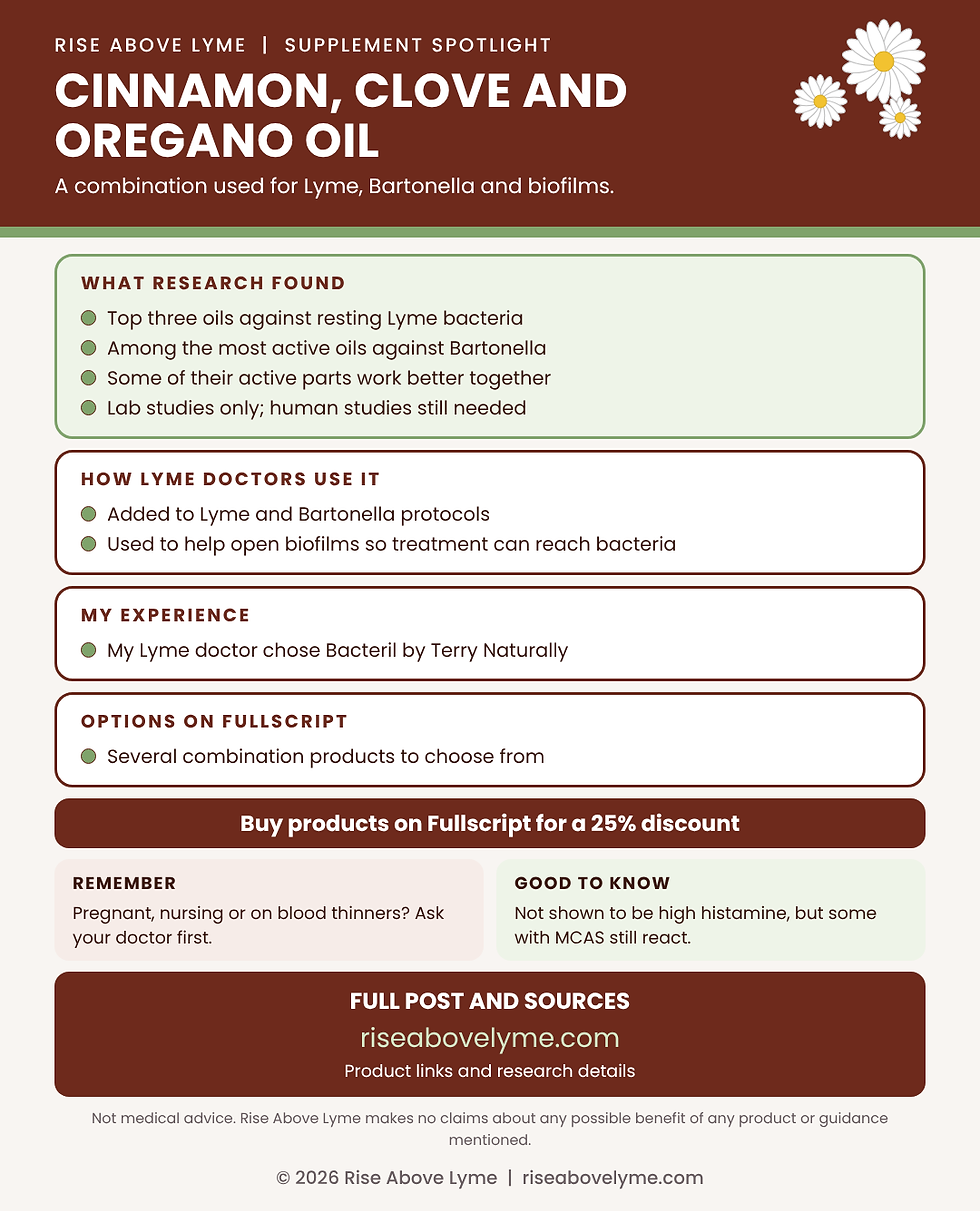
Short on time or energy? A quick-view graphic with the key points is at the bottom of this post.
WHY THESE THREE OILS
-In a 2017 Johns Hopkins lab study, oregano, cinnamon bark and clove bud oils were the top three oils against the hard-to-kill "resting" form of Lyme bacteria. These three kept the bacteria from growing back, and some of the top oils also broke up biofilm-like clumps.
-Each oil has its own main active part: carvacrol in oregano, cinnamaldehyde in cinnamon and eugenol in clove. Carvacrol and cinnamaldehyde both cleared resting Lyme bacteria in the lab.
-In a 2019 lab study from the same group, oregano and cinnamon bark oils were among the most active oils against Bartonella, and clove bud oil worked well too.
-For Babesia, the research is still early. In a 2020 lab study from the same group, clove and oregano oils showed some activity against Babesia, but garlic and black pepper oils worked best. A separate 2020 study found cinnamon bark extracts (not the oil) slowed several types of Babesia in the lab and slowed Babesia microti in mice. As of 2026, I couldn't find any newer studies on these oils for Babesia.
WHY THEY'RE COMBINED
-A 2025 review explains that these oil compounds mainly work by damaging the outer membrane of bacteria so it leaks. Some of them worked even better when paired with each other or with certain antibiotics, though that research was done on other types of bacteria, not Lyme.
-All of this research was done in the lab, and the researchers say clinical trials in people are still needed.
HOW LYME LITERATE DOCTORS USE IT
-Dr. Richard Horowitz lists the cinnamon, clove and oregano oil combination among his biofilm agents for Bartonella, to help open biofilms so antibiotics can reach the bacteria. He uses oil of oregano on its own if someone can't tolerate cinnamon or clove.
-Dr. Marty Ross includes a liposomal cinnamon, clove and oregano oil capsule in his top herbal plan for Bartonella, and these oils are among the herbal combinations in his Lyme protocol.
-Every Lyme doctor has their own approach, and that's okay. Talk with your doctor before adding it.
MY EXPERIENCE
-My Lyme literate doctor chose Bacteril by Terry Naturally for me. I've only used oil of oregano in combination products like this one.
BEFORE YOU START
-Talk with your doctor first if you're pregnant or nursing. Larger amounts of Ceylon cinnamon are considered unsafe in pregnancy, and clove oil isn't recommended during pregnancy or nursing.
-If you have MCAS or histamine intolerance, start slowly and with your doctor's guidance. Here's what I found:
-I couldn't find any study that measured cinnamon, clove or oregano as high in histamine, or showed they trigger histamine release.
-Histamine food lists disagree. Some lists from mast cell sites flag cinnamon and clove as higher histamine, while others rate them as well tolerated. Oregano is rated low on every list I checked.
-Lab and animal studies point the other way. Compounds in cinnamon, clove and oregano calmed mast cells or lowered histamine, but this hasn't been tested in people.
-Even so, people with MCAS can still react. Possible reasons include allergic reactions, skin irritation (cinnamon oil can cause contact dermatitis), salicylates (oregano and clove are among the higher-salicylate spices), or strong scents. Triggers vary widely from person to person.
-Cassia cinnamon contains coumarin, which can affect the liver. Check with your doctor if you have liver problems.
-Clove oil may raise the risk of bleeding if you take blood thinners.
-These oils can irritate the stomach in some people.
-Keep them out of reach of children.
WHERE TO BUY
Buy products on Fullscript for a 25% discount
Buy here (Bacteril by Terry Naturally: cinnamon bark, clove bud, oregano and thyme oils. The one my Lyme literate doctor chose for me):
Buy here (Microb-Defend by BioMatrix: thyme, clove and oregano oils, no cinnamon):
Buy here (Herbal Biotic by Return Healthy: oregano and clove bud oils, plus Japanese knotweed, black walnut, Houttuynia, cat's claw, andrographis and Chinese skullcap. Contains black walnut, a tree nut):
RELATED POSTS
Oil of Oregano
Natural Antibiotics
Essential Oils
SOURCES
Current Issues in Molecular Biology - Lights and shadows of essential oil-derived compounds: antimicrobial and anti-inflammatory properties of eugenol, thymol, cinnamaldehyde, and carvacrol (November 2025)
LymeDisease.org - Dr. Richard Horowitz, Medical Detective: Effective treatments for Bartonella infections (February 2025)
Dr. Marty Ross, Bartonella treatment guide (updated 2026)
Dr. Marty Ross, The Ross Lyme and Tick-borne Diseases Protocol (2024)
Johns Hopkins Chronic Fatigue (ME/CFS) Clinic - Low histamine diet (April 2026)
NIH National Center for Complementary and Integrative Health - Cinnamon (November 2024)
Antibiotics - Ma et al., Essential oils with high activity against stationary phase Bartonella henselae, Johns Hopkins lab study (November 2019, older source, still worth reading)
Antibiotics - Feng et al., Identification of essential oils with strong activity against stationary phase Borrelia burgdorferi, Johns Hopkins lab study (October 2018, older source, still worth reading)
Global Lyme Alliance - Essential oils, garlic, herbs and spices kill persister Lyme disease bacteria (December 2018, older source, still worth reading)
Frontiers in Medicine - Feng et al., Selective essential oils from spice or culinary herbs have high activity against stationary phase and biofilm Borrelia burgdorferi, Johns Hopkins lab study (October 2017, older source, still worth reading)
European Medicines Agency - Assessment report on clove (2011, older source, still worth reading)
Molecules - Batiha et al., Phytochemical characterization and chemotherapeutic potential of Cinnamomum verum extracts on the multiplication of protozoan parasites in vitro and in vivo (February 2020, older source, still worth reading)
Pathogens - Zhang et al., Identification of essential oils including garlic oil and black pepper oil with high activity against Babesia duncani, Johns Hopkins lab study (June 2020, older source, still worth reading)
Swiss Interest Group Histamine Intolerance (SIGHI) - Food compatibility list, histamine (August 2024)
Practical Gastroenterology - Dr. Matthew Hamilton and Kate Scarlata, Mast cell activation syndrome: what it is and isn't (June 2020, older source, still worth reading)
Food & Function - Gajewska et al., Dietary salicylates in herbs and spices (September 2019, older source, still worth reading)
Avicenna Journal of Phytomedicine - Boskabady et al., Carvacrol attenuates serum levels of total protein, phospholipase A2 and histamine in asthmatic guinea pig (November 2016, older source, still worth reading)
European Journal of Nutrition - Hagenlocher et al., Cinnamaldehyde is the main mediator of cinnamon extract in mast cell inhibition (2015, older source, still worth reading)
Pharmacological Research - Kim et al., Antianaphylactic properties of eugenol (1997, older source, still worth reading)
Disclaimer: Rise Above Lyme makes no claims about any possible benefit of using any product mentioned within this site. Always consult with your doctor before adding anything. The information shared is based on personal experience, years of accumulated researched resources from Lyme Literate doctors and polls conducted within Lyme groups from actual patient experience using these solution ideas.


Comments